Harnessing the Power of Marine Currents.
Vortex Hydro Power develops a novel, ground-breaking technology, the VIVACE (Vortex Induced Vibrations for Aquatic Clean Energy) Converter, to extract clean, predictable energy from river and ocean currents and tides.
A spin-off company from the Marine Renewable Energy Laboratory, University of Michigan since 2005 with exclusive rights to VHP for 13 patents from the U.S.A., the EU, and Brazil.
Rethinking Marine Energy.
Why traditional hydro power isn't enough, and how VIVACE changes the game.
The Problem
Conventional tidal and river turbines require high water speed (over 4 knots=2m/s) to operate efficiently. Dams and turbines raise several ecosystem concerns such as high-speed rotating blades, fish and people safety, noise, and aesthetics. Costs of infrastructure and maintenance add to the problem.
The Solution
VIVACE greatly expands our ability to produce MHK energy by harnessing flows as slow as 0.5m/s in an environmentally compatible way. The VIVACE Converter mimics fish-school dynamics using naturally occurring fluid-structure interaction phenomena between oscillating cylinders and flows. Oscillations are just 20% faster than the flow, thereby presenting no danger to people while providing a vortical wake where fish thrive.
The VIVACE Converter.
Biomimetic engineering designed for maximum efficiency and zero environmental harm.
Ready for commercial deployment? Explore the technical specifications, scalability metrics, and ROI potential of VIVACE arrays.
↓ Download BrochureFor engineers, academics, and deep technical data:
📄 Request the Technical Brochure →Biomimetic Engineering
Designed for maximum efficiency and zero environmental harm, operating safely alongside marine ecosystems.
Massive Scalability
Modular design allows deployments ranging from portable, remote river applications (1kW) to massive, grid-connected ocean arrays (>100kW).
Autonomous Operation
Reduces the need for manual monitoring and inspection, leading to significant cost savings in labor and operational expenses.
Simplified Maintenance
Inspection is simple. With very few moving parts, VIVACE dramatically increases durability and decreases periodic maintenance routines.
Smart Telemetry
Optional real-time data collection and processing capabilities for continuous performance optimization and grid integration.
Unmatched Power Density
VIVACE achieves 602W/m³ (@1.3m/s). For scale, conventional windfarms operate at 0.01W/m³ (@12m/s), and heavy diesel engines at 25kW/m³.
How It Works.
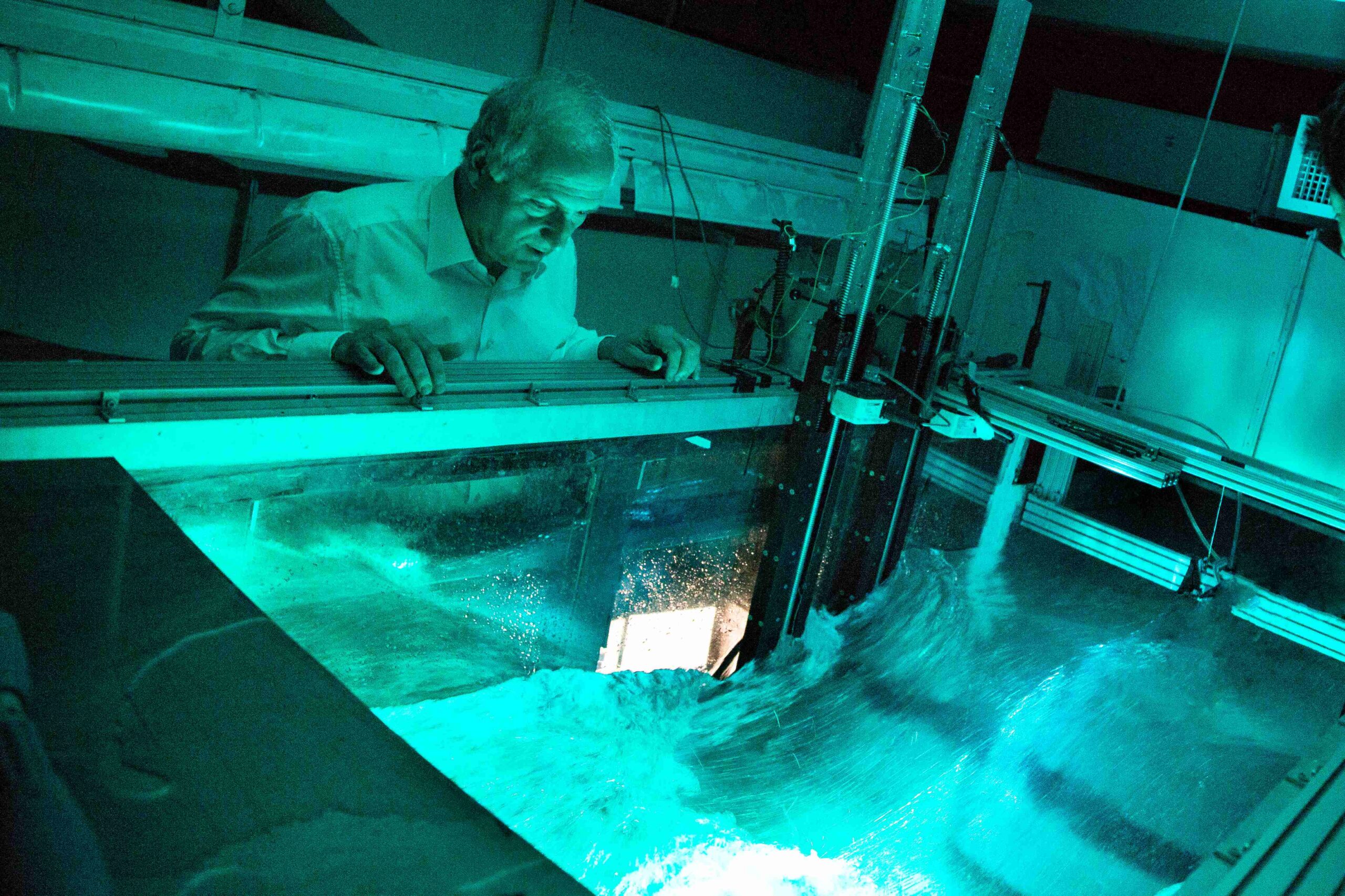
How VIVACE Works to Harness MHK Energy
VIVACE utilizes FIO (Flow Induced Oscillation) by creating and amplifying it rather than suppressing it, which is the traditional goal in engineering to avoid structural damage.
FIO includes vortex-induced vibrations, galloping and their coexistence. The process follows these steps:
1 Vortex Shedding: When a current flows around a submerged, elastically supported cylinder (or an array of them), vortices form and shed alternately above and below the cylinder.
2 Pressure Imbalance: The alternating shedding of vortices creates a pressure imbalance, inducing transverse (up-and-down) vibrations.
3 Mechanical Oscillation: The cylinder, mounted on springs, moves up and down. This motion is termed Flow-Induced Oscillation (FIO), which includes VIV and galloping at higher speeds.
Energy Conversion: The mechanical energy from the oscillation is converted into electricity by a power take-off (PTO) system, typically through a linear generator or by driving a rotary generator.
Underlying Physics.
PhD and publication activities focus on the following topics: (1) Enhancement of high damping VIV and galloping for energy harnessing, (2) expansion of the TrSL3 regime of high lift, (3) optimal FIO damping for energy harnessing, (4) power take off, (5) high damping VIV hysteresis...
(6) passive turbulence control for FIO enhancement, (7) fish-biomimetics for energy harnessing, (8) CFD to visualize the cause of parametric bifurcations and temporal bi-stabilities, (9) flow past cylinder arrays, (10) adaptive damping, (11) nonlinear spring and damping models for energy conversion, and (12) synergistic FIO of multiple bodies in currents.
Testing.
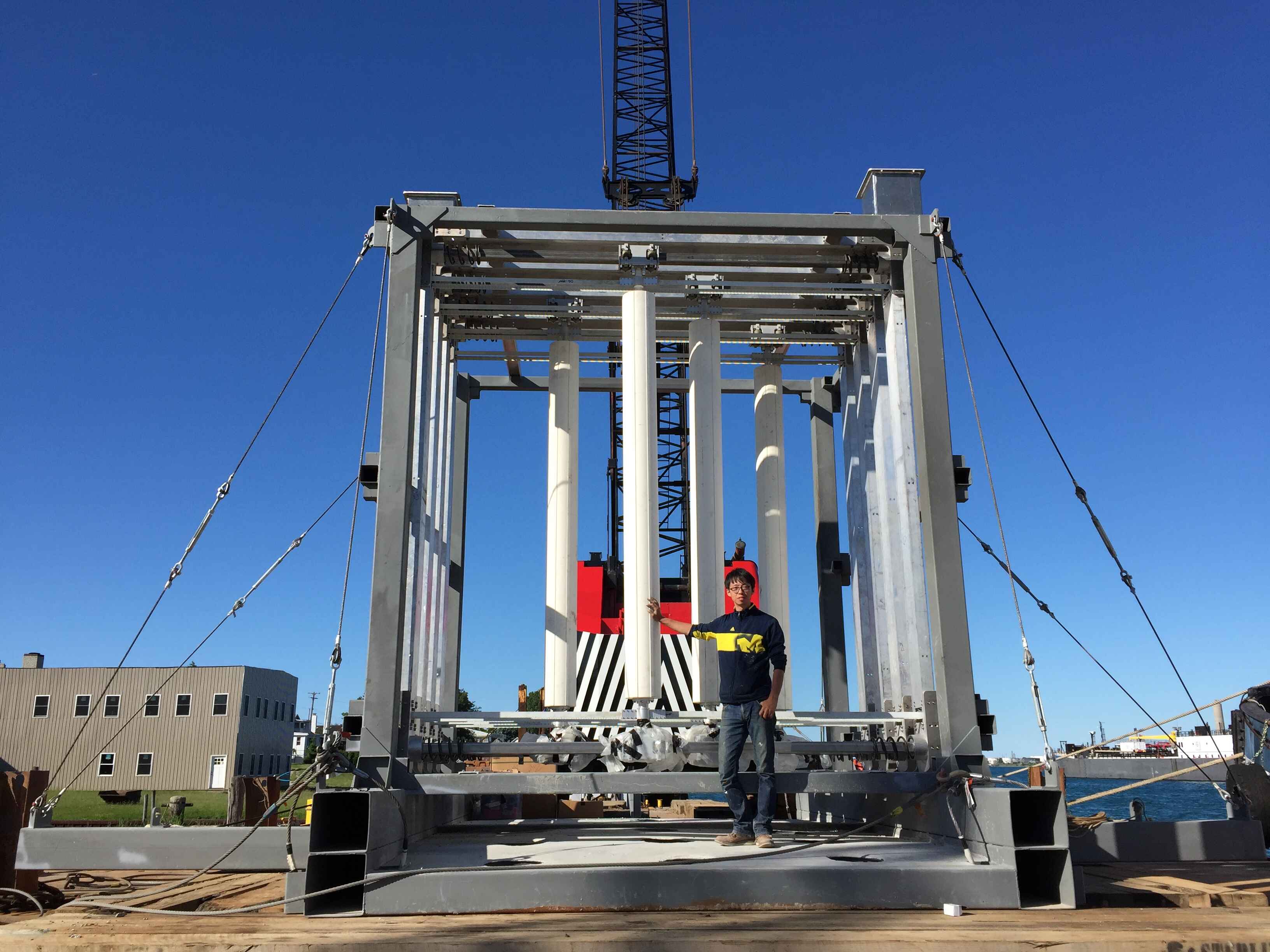
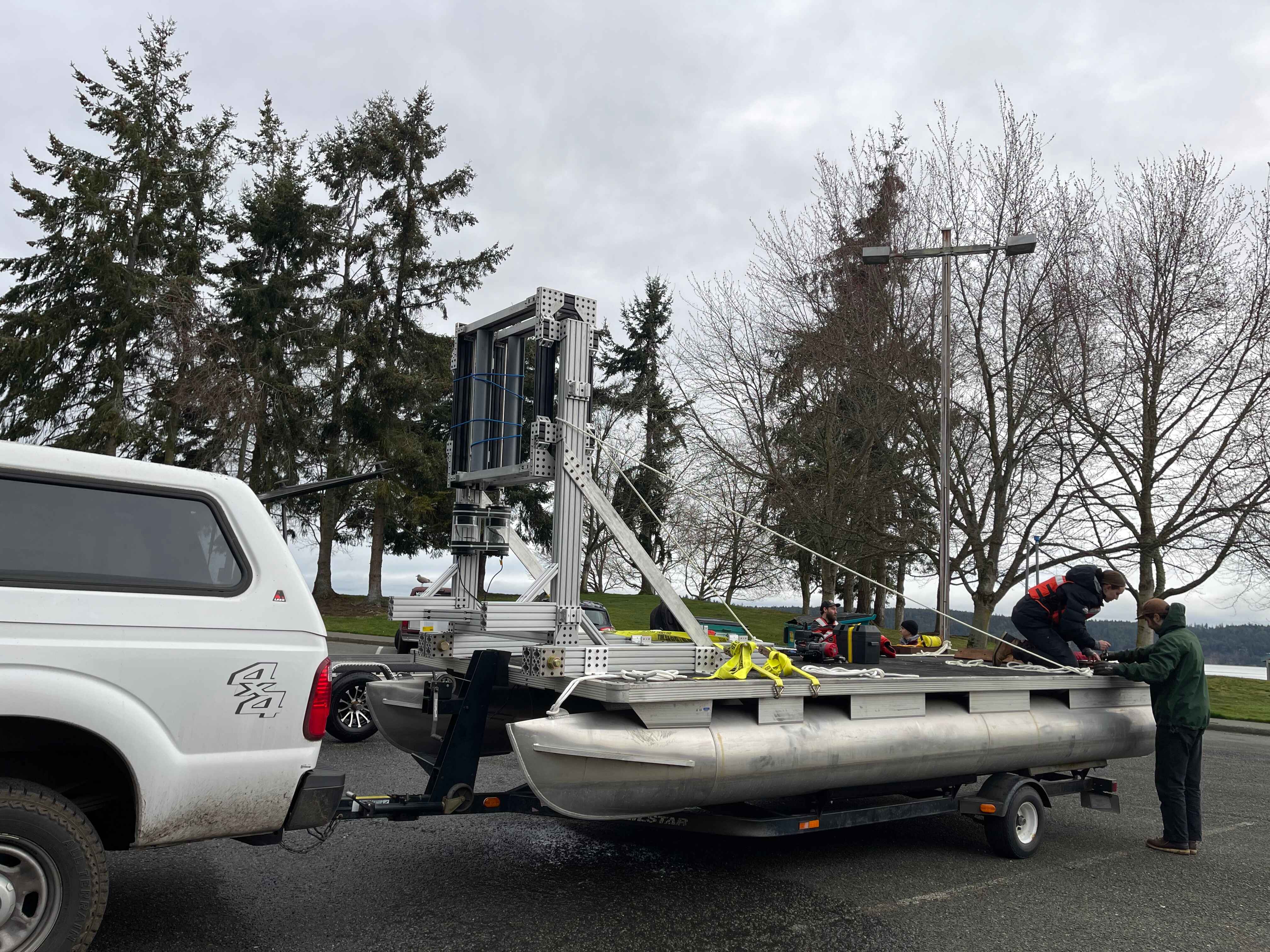
The MRELab has been conducting fundamental research and testing at various scales and locations (see Gallery):
- Ocean Testing: By PNNL in March 2025
- River Testing: In the St Clair River in Port Huron MI in 2010, 2012, 2016 and in canals in the Netherlands
- Towing Tank Testing: University of Michigan, Marine Hydrodynamics Lab.
- Recirculating Channel Testing: Fifteen years of testing in a dedicated channel, have generated a large experimental database by developing a controller-based stiffness and damping system. It emulates linear and nonlinear models and enables instantaneous parameter setting.
- Dry Testing: Testing power conversion with a PTO (Power Take Off) system
- Computational Fluid Dynamics: Understanding parametric bifurcations and temporal bi-stabilities
Model parameters include: Reynolds Number Re [8×10³ - 1.5×10⁵], mass ratio m* [1.0 - 3.14], current velocity U [0.35 m/s - 1.15 m/s], aspect ratio L/D [6-36], damping ratio [0.02-0.26], and spring stiffness. Four design parameters for Passive Turbulence Control via surface roughness and three fish-tail parameters complete the current matrix of parametric tests.
Education.
Since the inception of MRELab in the summer of 2005, over 150 students have worked or are working in the lab at all degree levels: 11 PhDs, 1 PE, 2 MBAs, 5 MEngs, 5 MSEs, and over 50 undergraduates. Also 15 post-doctoral fellows and visiting scholars from around the world have researched and collaborated in the MRELab.
Researchers study marine hydrodynamics, designing and conducting experiments, boundary layers, vortex-induced vibration, galloping, laser visualization, energy harnessing, power take-off, system integration, passive turbulence control, fish-biomimetics, marine renewable energy, environmental impact of energy harnessing, tech-transfer of an innovative idea, patenting process.
Milestones.
The underlying physics of VIVACE is very complex. As a reference point of a device converting energy in flows, is the propeller problem. It is being studied for over 150 years and consists of fixed geometry and lifting surfaces in steady flow producing steady lift. VIVACE geometry is changing in real time, components are in FIO, and lift is oscillatory. Several research breakthroughs have been achieved to reach the current Technology Readiness Level of TRL7.
| Date | Major Milestones |
|---|---|
| 2005–06 | Invention; patent application; introduction at the OMAE-2006 Conference |
| 2006–07 | Proof of concept and MRELab tests |
| 2006–09 | Systematic tests in MRELab on one-cylinder FIOs. Back-to-back VIV and galloping enabled high-response, open-ended RAO. |
| 2008–09 | Towing tank tests (University of Michigan): large cylinders in critical and post-critical flows |
| 2009–11 | Map of Passive Turbulence Control to FIO. Enabled selective triggering of FIO and early onset of galloping, right after VIV. |
| Aug. 2010 | First field tests of two horizontal cylinders in tandem in the St. Clair River |
| 2009–2015 | 1st and 2nd generation of Vck controller emulating damping and spring |
| 2011 | Galloping before VIV desynchronization, with more than 4-diameter amplitude |
| 2010–12 | Holistic approach to studying multi-body synergistic FIO in the MRELab |
| 2009–13 | Developed dedicated CFD codes (verified and validated) to complement experiments and understand interactions between shear layers, vortices, and bodies |
| Sep. 2012 | 2nd field test of one vertical cylinder in the St. Clair River |
| Dec. 2012 | 3rd field test in canals in The Netherlands with shorter cylinders in non-uniform flow |
| Jan. 2013 | 4th field test in canals in The Netherlands with shorter cylinders in non-uniform flow |
| 2015 | Proved that two cylinders in synergistic FIO produce 2.7–7.5× the power of a single isolated cylinder |
| 6/9/2016 | Oscylator-4 tested for three months in the St. Clair River. Four vertical cylinders in galloping. Proven good durability: TRL6–TRL7 |
| 2016 | Three cylinders in synergistic FIO produce 3.4–over 5× the power of a single isolated cylinder |
| 2015–17 | Achieved fluid–structure–space interaction to make VIVACE a real 3-D converter with a high power-to-volume ratio |
| 2019 | Introduced adaptive nonlinear damping control for harnessing energy; up to 94% increase in efficiency |
| 2019 | Eigen solution at the fluid–structure interface; OMAE-2019 |
| 2020 | Operation in very slow flows (0.2 m/s) and in turbulent flows by redesigning turbulence stimulation |
| 2021 | Identified optimal power oscillation modes. Managed to trigger optimal modes by matching fish undulation shapes. |
| 2021 | Redesigned VIVACE to harness energy from both currents and waves |
| 2022 | Adaptive damping enabling fish kinematics for maximum energy conversion without control |
| 2023 | Complete dry testing with 1-4 oscillators and PTO |
| 2024 | Complete towing tank testing at UofM with 1-4 oscillators and PTO |
| 2025 | Ocean testing by PNNL (Pacific Northwest National Lab) of DOE |
Historical Development Archive
Download the presentation deck featuring early conceptual testing and historic video slides.
Impact.
The VIVACE Converter pioneered the research and development of harnessing Marine Hydrokinetic energy from slow currents, rivers, and tides without using blades, rotors, or dams. VIVACE works efficiently in high speeds as well because its underlying physics is highly scalable.
It is environmentally friendly as it mimics fish-school dynamics without enforcing the complexity of fish kinematics. Cylinders move quietly and slowly (20% faster than the flow). It receives regularly invitations from communities for deployment.
Ready to Partner with Vortex?
Join us in pioneering the next generation of marine renewable energy. Reach out for deployment inquiries or research collaborations.